

Prompt Design: A Guide to Gen AI creation in Text and Image
In this workshop participants will learn strategies for successful prompt design (or prompt engineering) for both text-based Generative AI platforms like Microsoft Co-Pilot and image Generative AI platforms like Adobe Firefly.
What to Expect
You will be guided through a set of critical and creative, hands-on engagements where you will produce prompts that result in more targeted content, learn to work iteratively as part of the generative AI process, and to utilize greater affordances of different platforms.
Pedagogical approaches & Faculty Success Stories
In this webinar particpants will be introduced to pedagogical guidelines and strategies for integrating AI / Generative AI into the classroom and hear from faculty who have used Generative AI successfully in their courses.
What to Expect
Session hosts and guests presenters will highlight low-stakes and high-impact practices for bringing AI into your work with students and showcase several examples of different levels of integration.
FEATURED GUESTS

Miranda Rodak is a Visiting Senior Lecturer in the Kelley School of Business at IU Bloomington and the former Director of IU’s system-wide faculty development program, the Mosaic Institute for Active Learning. Prior to Mosaic, she served as the Director of Undergraduate Teaching in the College of Arts & Sciences, where she directed multi-section writing courses annually serving 6,000 undergraduates and supporting 100+ SAAs with scaffolded professional development and teacher training. Her scholarship focuses on innovative pedagogies that promote AI and digital literacies, metacognitive learning, and inclusive, collaborative, high-impact practices.

Braddock is the STEM Coordinator with the Groups Scholars Program, a member of CITL’s AI Faculty Learning Community, and a 2025 IU Digital Gardener Faculty Fellow.
Ben has worn many hats over the course of his career in higher education (Positive Life Coach, Res Life, academic advisor, & instructor). He is not a “tech person” by training, but his passion for growth, development, and innovation in the field of education have led him on his own journey towards “AI literacy.” Ben is hoping to save you time by sharing some of the lessons he has learned along the way.
Scaffolding AI/GenAI into the Classroom
This workshop will guide participants through approaches for integrating AI / Generative AI into the classroom. It will build on the insights from the previous webinar and focus on integrating AI/GenAI as part of a unit or multi-unit plan.
What to Expect
This session will present examples and considerations for how you might use AI/Generative AI platforms in your courses. It will feature options for getting students to use these tools critically and ethically and offer guidance on how to create activities and assignments for students: i.e., leveraging AI/Generative AI as part of active learning engagements, as part of an assignment or skill development sequence, and as potential collaborators for students when working on projects.
FEATURED CO-HOST
Miranda Rodak is a Visiting Senior Lecturer in the Kelley School of Business at IU Bloomington and the former Director of IU’s system-wide faculty development program, the Mosaic Institute for Active Learning. Prior to Mosaic, she served as the Director of Undergraduate Teaching in the College of Arts & Sciences, where she directed multi-section writing courses annually serving 6,000 undergraduates and supporting 100+ SAAs with scaffolded professional development and teacher training. Her scholarship focuses on innovative pedagogies that promote AI and digital literacies, metacognitive learning, and inclusive, collaborative, high-impact practices.
Meaningful Assessments in the Age of AI: Policy and Practice (Part 1)
This webinar session focuses on thinking through how to incorporate generative AI into your teaching and classroom and what that means for assessments.
What to Expect
The session will begin by discussing why it is important to publish and remind students of your policy on AI and how that can also reflect a larger investment in transparency. One of the more research-supported concepts in Teaching and Learning, adding transparency supports more equitable teaching but can also benefit every student. This webinar will cover:
- What policies exist and why your classroom policy is important.
- The benefits of adding more transparency.
- How to TILT your assignments with AI in mind.
The session facilitators look forward to your participation and hearing your questions!
SESSION CO-FACILITATORS

This session will feature co-facilitators: Instructional Technology Consultant Eric Brinkman (they/them) and Distance Learning Specialist Maggie Gilchrist (she/hers) from IU Bloomington's Center for Innovative Teaching and Learning.
In addition to playing a key role in the conversation, Brinkman and Gilchrist will highlight the core Canvas assets they’ve built around AI / Generative AI Assessment.
Meaningful Assignments in the Age of AI: Transparent Assignments (Part 2)
This workshop will explore Generative AI as a productivity tool in relation to teaching and learning. It will feature guides for using Gen AI to not only spark critical thinking but also to increase participants own capacities and efficiencies (especially related to teaching productivity).
What to Expect
In this workshop the facilitators will demonstrate and guide you through using an AI prompt to suggest assignment designs. They will also show how to employ an AI prompt to help TILT an assignment. During the session you will learn to:
- Employ generative AI to spark creative assessment ideas.
- Use AI to support TILTing an assignment.
- Add transparency to improve learning outcomes and avoid academic misconduct issues.
This is intended to be a workshop, so be sure to have access to a device that can use Gen AI and be sure to bring an assignment description you might like to TILT.
The facilitators look forward to your participation and hearing your questions!
SESSION CO-FACILITATORS
This session will feature co-facilitators: Instructional Technology Consultant Eric Brinkman (they/them) and Distance Learning Specialist Maggie Gilchrist (she/hers) from IU Bloomington's Center for Innovative Teaching and Learning.
In addition to playing a key role in the conversation, Brinkman and Gilchrist will highlight the core Canvas assets they’ve built around AI / Generative AI Assessment.
Career Readiness & Student Success with AI/GenAI
This webinar will feature a panel discussion exploring the way Gen AI is factoring into student success. It will look at these issues in terms of learning and development, the college-to-career transition, and the related impact on higher education in the state of Indiana.
What to Expect
Our esteemed panelists will offer critical perspectives on how GenAI is factoring into career readiness. Panelists will engage in conversations around the degree and depth to which GenAI literacies are becoming integral to not only the higher education learning experience but the expectations/needs of employers.
PANELISTS
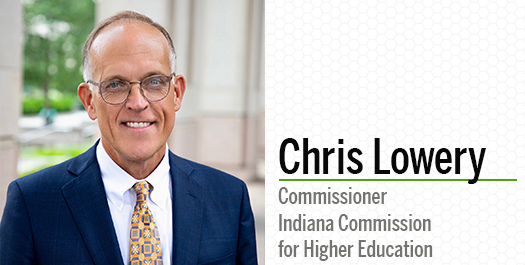
Chris Lowery was appointed in 2022 to serve as Commissioner for Indiana’s Commission for Higher Education, the coordinating agency charged with ensuring the state’s postsecondary education system is aligned to meet the needs of students and the state. Prior to joining the Commission, Lowery was senior vice president, workforce, careers, and adult strategy at Ivy Tech Community College where he provided overall leadership of Ivy Tech workforce and career initiatives and organization. Before working in higher education, Lowery led public policy and engagement for Hillenbrand, Inc. and served as an aide to former Indiana Governor Robert D. Orr and then-Senator Dan Quayle.
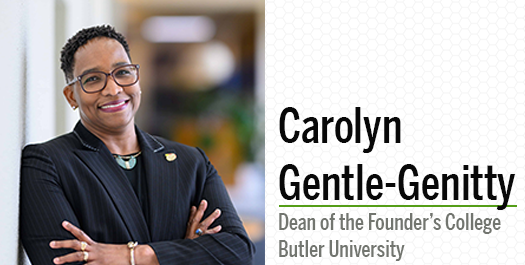
Dr. Carolyn Gentle-Genitty is a highly accomplished executive and international research scholar, spanning 25 years in higher education, social work, academic affairs, and leadership roles. She has been involved in constructing policy action statements, optimizing standard operating procedures, cultivating visions for long-term institutional change, emphasizing shared ownership of change, embedding performance evaluations around expected change, and creating articulated policy practices.
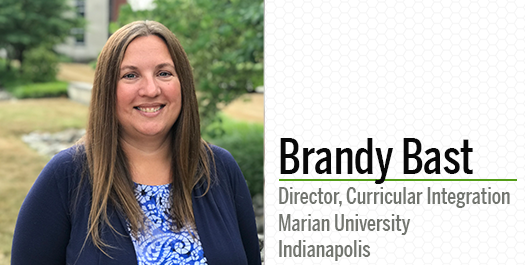
Brandy Bast is an education and workforce development professional with over a decade of experience in career development, curricular design, and teaching. As the Director of Curricular Integration at Marian University, she leads career readiness initiatives, collaborating with faculty, staff, and industry partners to enhance student success. She also teaches sophomore and senior-level career courses, actively integrating GenAI to help students with career development in ethical and practical ways. Through this course, students learn to leverage GenAI for a range of activities, including career and industry research, resume development, interview preparation, job search planning, and LinkedIn. Brandy is dedicated to preparing students for the evolving workforce through innovative programming and strategic partnerships.
Student Learning & Engagement with AI/GenAI
This workshop will offer guidance in how AI/GenAI can be used to aid in student learning. It will feature modules, practices, and considerations to better prepare students to leverage Gen AI in their own learning practices and situations.
What to Expect
This session will explore existing student-focused modules in Canvas as well as emerging strategies with GenAI students can use to improve learning, engagement, and success in their courses. While it focuses on the student component, it will do so from a faculty/instructor professor: empowering educators, through resources and strategies, to help students leverage GenAI in critical and ethical ways as part of their learning journey.
FEATURED GUEST
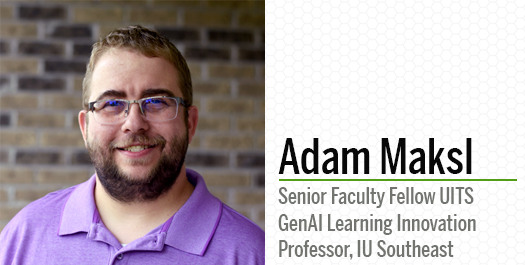
Adam Maksl is a professor of journalism and media at Indiana University Southeast in New Albany, Indiana. He teaches courses focused on digital journalism and researches news and media literacy. He is also Senior Faculty Fellow for GenAI Learning Innovation & Co-Director of the GenAI Learning Lab through UITS Learning Technologies, former Manager for eLearning Innovation within Indiana University’s eLearning Design & Services unit, and co-founder and former co-director of the Digital Gardener Initiative, IU's university-wide digital literacy initiative.
GenAI, Higher Ed, & Industry/Community Partners
This webinar will feature a panel conversation on current and coming state of the relationships between higher education and industry and/or community partners. Panelists will offer critical insights on how GenAI is influencing these key practices and partnerships.
What to Expect
This session will bring together industry, community, and higher education experts to take a critical look at how the emergence of AI/GenAI platforms and related practices are impacting industry and higher education relationships as well as higher education and community practices.
FEATURED PANELIST

Bevon Joseph is a financial literacy advocate, mentor, and speaker dedicated to equipping parents, students, and underserved communities with the tools to achieve long-term economic security. With over 15 years of experiences in financial services, workforce development, and community engagement, he simplifies complex financial concepts into practical, actionable lessons.
As Founder & Principal Consultant of Impact-Focused Tech Solutions LLC and Co-Lead of Campus Coin Invest, Joseph develops financial education initiatives, career readiness training, and technology-driven financial solutions for schools, nonprofits, and workforce organizations. His expertise spans financial literacy, college savings, workforce development, AI-driven financial education, and social capital building.
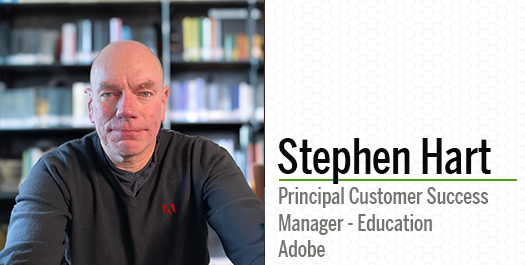
Stephen Hart is creative and strategic media technology professional with a multi-decade background in journalism, creative, photography and production environments. He currently holds the role of Principal Customer Success Manager for Education at Adobe, where he helps higher education institutions leverage the power of Adobe tools and platforms. With his wealth of experiences of working on the cutting edge of digital technologies and doing so across range of professional industries (from the Associated Press to Adobe), Stephen is particularly adept at translating complex technical topics to non-technological audiences.
AI/Gen AI in My Professional Work
The final workshop for this series will offer participants a range of use cases for academic uses of AI / Generative AI and situate strategies for employing these platforms in everyday scholarly practices.
What to Expect
This session will feature experts demonstrating how they use Gen AI tools in their academic work and offering pragmatic approaches/insights across disciplinary frames. It will feature a refined exploration of Prompt Design and present additional strategies for critical and creative academic collaborations between human authors and Generative AI partners.
The core of this session is designed to help you identify and create customized strategies and uses for Gen AI specific to your area(s) of expertise.
CO-FACILITATORS
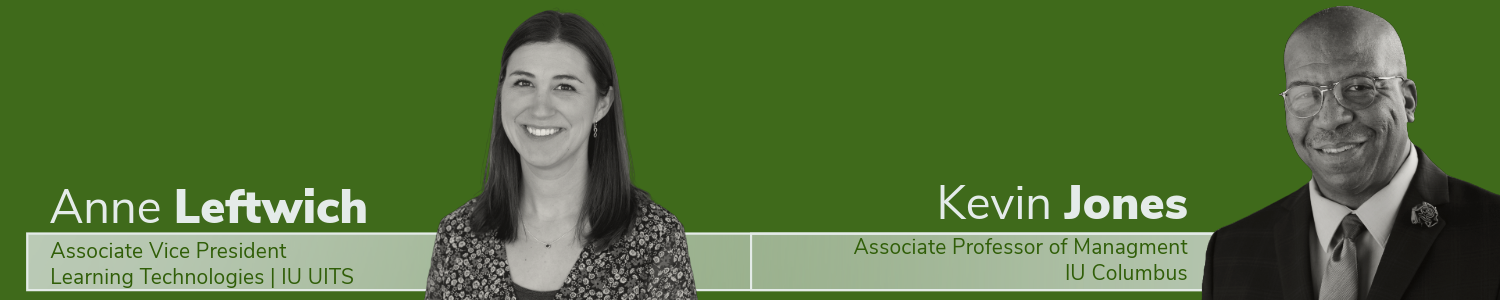
Anne Ottenbreit-Leftwich, Ph.D., is the Barbara B. Jacobs Chair in Education and Technology. She is a professor of Instructional Systems Technology within the School of Education and an adjunct professor of Computer Science at Indiana University Bloomington. Dr. Leftwich’s expertise lies in the areas of the design of technology/computer science K-12 curriculum resources, and development/implementation of professional development for teachers and teacher educators. Dr. Leftwich investigates ways to teach computer science and ways to prepare preservice and inservice teachers to teach CS. She is a co-PI for the Expanding Computing Education Pathways (ECEP) Alliance, which seeks to broaden participation in computing at the K-16 levels. Her research focuses on the adoption and implementation of technology and computer science at the K-12 levels.
Kevin Jones, Ed.D. is an associate professor of management at Indiana University Columbus and the Director of the Indiana University Columbus, Center for Teaching and Learning. He is also an Indiana University Digital Gardener Fellow exploring ways to boost digital literacy among faculty and students. His professional work is dedicated to enhancing the results of organizations by applying organizational change practices to improve how individuals and teams perform, use technology optimally, and communicate effectively. His research interests cover various topics from leadership skills to ethical AI use.
Looking forward to Fall 2025: Some Future Considerations
This webinar will feature panelists engaging in reflective and projective practices. They will situate the current “state of things” with AI/Generative AI and higher education, and point to potential trends and emergent considerations for the coming academic year.
What to Expect
This session will include a critical focus on trying to take what we've learned to this point in the AI/GenAI higher education journey and offer some insights and considerations for what the landscape might look like heading into Academic Year 2025-2026.
PANELISTS
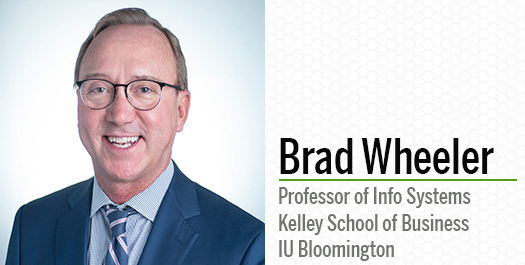
For 19 years, Dr. Brad Wheeler served in IU’s IT leadership team and 13 as Vice President for IT & CIO with responsibilities for almost $200M in IT services and grants. He was concurrently IU Vice President for Communications and Marketing from 2018-2020 and served as Interim Dean for the Luddy School of Informatics, Computing, and Engineering in 2015-2016.
He has taught graduate students and international executive education audiences at the Kelley School since 1996 and serves on both corporate and non-profit boards.
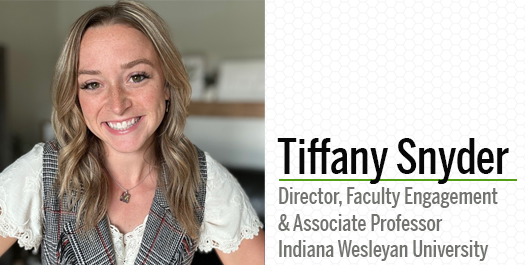
Dr. Tiffany Snyder is the Director of Faculty Engagement and an Associate Professor at Indiana Wesleyan University (IWU), where she leads professional development for full-time and adjunct faculty on the National & Global (N&G) campus, with a focus on hybrid and online programs.
Since the release of ChatGPT 3.5 in November 2022, Dr. Snyder has led numerous GenAI initiatives, including workshops, webinars, graduate courses, professional learning communities, and conference presentations. She is also a published scholar, collaborating with students and colleagues on research exploring GenAI’s impact on teaching and learning.
Dr. Snyder has co-hosted the Digital2Learn podcast since 2018, featuring global guests and weekly episodes on innovative teaching and learning. She holds a Ph.D. in Psychology with an emphasis on technology and learning from Grand Canyon University, along with an M.A. in Student Development Counseling and Administration and a B.S. in Psychology and Leadership from IWU.
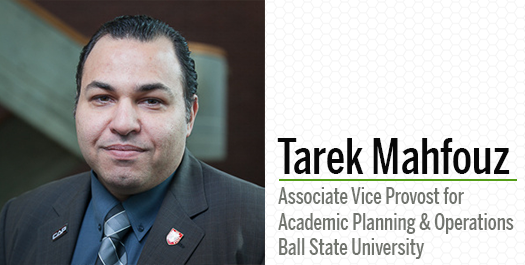
Dr. Tarek Mahfouz is the Associate Vice Provost of Academic Planning and Operations at Ball State University. A Professor of Construction Management with over a decade of service to Ball State University, he has held significant leadership roles, including Associate Dean of the R. Wayne Estopinal College of Architecture and Planning and University Senate Leader.
With a Ph.D. in Civil Engineering from Iowa State University and degrees from the American University in Cairo, Dr. Mahfouz is an accomplished researcher specializing in Knowledge Management, Machine Learning, Decision Support, and Statistical Modeling. He has published over 35 peer-reviewed articles and is known for his collaborative, inclusive leadership approach.